Friday, July 9, 2021

Review: Consider Phlebas

Consider Phlebas Consider Phlebas by Iain M. Banks
My rating: 3 of 5 stars

I've been told that this isn't a great start to Banks' work. That he has much better stuff in his catalog and starting with this might turn you off. After finishing Phlebas, I can see why people would say that. Not because his other stuff is good (to be fair, I haven't read it yet), but because this book is so meh. It tries so hard to entertain and impress, but I can't help but feel a dryness to it. Not Kim Stanley Robinson kind of dry, but more of a licking sandalwood kind of dry.

The book is just fine in most areas, think in the arenas of pacing and prose, but what it fails in sticks out so much more because what it succeeds in it only does so in the mildest of terms. The uninteresting characters are so much blander because the pacing is only modest. There is also a severe lack of scope that undercuts everything else. The world this book takes place is suppose to be so much bigger but the narrative is so two-dimensional. No book is perfect, but what is wrong with it happens to stand out so much more than what actually works.

Also, action doesn't equal plot development. Just because characters are throwing their fat around, doesn't mean the plot is actually moving. This is more of a general comment that applies to most books, but it needed to be said.

Double also, the only science fiction book that can justify having an appendices is Dune. Not even the works of Asimov or Clarke can get away with that shit. Get the fuck over yourself.

If this book succeeds in one thing more than any other, is that it sparked a debate within me between the nature of fantasy and science fiction writings. It stuck out to me that this book claims to be science fiction but mostly reads like a fantasy novel. If you asked a random person if a book that contains a religion called the 'Circle of Flame' and asked them if it was science fiction and fantasy, what do you think their answer would be? I'm not saying books in well-defined genres need to be written in a certain way, but the debate persisted. I don't have a clear answer, but anyone reading it might also notice it.

Am I going to read more of Banks? Probably not. Maybe one day to spite those who say his other works are good, but for now they win this one. I rushed through the latter half of this book, and I only do that when the book is super good or I just want the pain to be over. This book isn't a broken arm painful but more like an annoying paper cut that just won't heal.

View all my reviews

Thursday, June 24, 2021

Review: If Beale Street Could Talk

If Beale Street Could Talk If Beale Street Could Talk by James Baldwin
My rating: 5 of 5 stars

There are some books you read because you want to. Some books to read just for shits and giggles. Some books because you want to complain about how badly literature has fallen. And there are some books you read because you need to. While the last one could probably describe all of Baldwin's work, there might not be a better example for a much needed emotional stirring than Beale Street. A fully encompassing tale about emotional bonds and the system that feels justified in breaking them.

Because I can't help being negative, I have to point out the plot is a little slow going. It opens by telling us why we're all here but takes some time to develop after that. I'm mostly only pointing this out because I've given other books lots of shit for pacing issues. The difference here is that Baldwin is a much better writer than the people of those other books. The subtext and underlying the family connections everyone shares is the main purpose of the book, the tragedy being that when systemic racism brings hell to one person, it brings hell to everyone he/she/they are connected to. The book needs time to establish those connections before the non-linear narrative explains itself.

The prose are some of the best I've ever read in modern literature. It's impactful, deep in emotion, and heavy in its intent. Even though it's short, I felt full by the time I finished. I didn't want anymore because I don't think I could handle it. Which is probably why it ends where it does.

I think what makes Baldwin's work so engaging is the subtle feeling of hope under the tide of tragedy and injustice. Being simultaneously anger and sad at the system that treats humans as less than that, but still being able to imagine a world that can be better. To quote Baldwin himself, "I am an optimist, because I am alive."  For all those who still feel they are alive, read this book. Because you need to.

View all my reviews

Wednesday, June 23, 2021

Review: Heavy Vinyl, Vol. 1: Riot on the Radio

Heavy Vinyl, Vol. 1: Riot on the Radio Heavy Vinyl, Vol. 1: Riot on the Radio by Carly Usdin
My rating: 3 of 5 stars

Most things are just alright. Books, movies, days. It's the nature of the universe that everything just settles into a bell curve. With that in mind, I try to temper all my expectations. I don't expect everything to knock it out of the park. Just as long as they get on base. This book? Yeah, it's just okay.

It's nearly perfect okayness mostly steams from the writing. I understood what was happening at all times, the commas and periods were all in the right places, and the characters weren't entirely two dimensional. But doing everything right doesn't mean you did well. Nothing was excessively creative, the plot was a little thin, and the writing wasn't as engaging as I would have hoped. There's pieces of coolness in this book, but most of it comes off as dry.

The art. Well the art is actually really good. Not and-the-award-goes-to good, but it exceeds its serviceable needs. Characters are well designed and drawn. Backdrops and settings don't feel lazy or uninteresting. Emotional impact and panel transitions  are all properly communicated. Given the so-so writing, the quality of the art actually stands out.

There is one thing that really bugs me though. No record store looks this nice or does this well business wise. I mostly say this because New Jersey's Vintage Vinyl, the best record store east of the Rocky Mountains just announced it is shutting down. A reminder that record stores struggle daily to stay in business and are mostly used by their cash strapped owners as storage. It's a cool fantasy, but I've seen D&D games with more realistic settings.

View all my reviews

Thursday, June 10, 2021

Review: Piranesi

Piranesi Piranesi by Susanna Clarke
My rating: 2 of 5 stars

I consider myself to be pretty pretentious, all the people who know me nodding simultaneously in agreement, but even I'm not pretentious enough to like "Piranesi". I'm going to try and keep this review as non-ranty as possible, but it's going to be obvious I didn't like this book. Or, to be more accurate, I'm going to explain why this book isn't good. Disliking something and knowing it's bad are two different things. In this case, both qualify.

For those reading this review who have no idea what this book is about, let me sum up: It's a journal of the universe's most boring genre character. It's not uncommon for books to have a fairly uninteresting main character in comparison to the supporting cast, but damn is Piranesi a boring person. He literally spends a good portion of the novel, especially in the beginning, just wandering around making notes about when birds show up. There is a motivation about finding some great knowledge, but it's such a generic idea that I rolled my eyes each time it came up. Also, the secret knowledge doesn't matter. At all.

The pacing is terrible. The so-called plot takes some time to get started, ramps up suddenly without warning, and then overstays its welcome after the climax. You would think a short book like this would have a tighter narrative. You would be wrong. Imagine watching an eight-hour-long debate on C-SPAN over the arrival of albatrosses, there's an explosion, and then the debate continues in the wreckage for two more hours. That's what reading this book felt like.

The prose are okay. If there weren't so many damn structural problems, I might have actually liked the writing in the book. Aside from most of it being boring, there are two problems with the writing I wanted to highlight. One, most of it is formatted in the way of a journal. That wouldn't be a problem in and of itself, but it's far too observational to be a journal. Journal entries are meant to self-reflective, processing the days' event(s) into a means for the person writing it to psychology examine. But the descriptive nature makes the book more of an artistic form of logging.  And there's a difference between keeping a journal and keeping a log. The biggest problem is that no one would write a journal or a log in this fashion. As normal prose, it's fine, but the journal structure mostly just ruins it. Two, it's trying too hard to impress C.S. Lewis. There's a difference between influence and imitation, and the prose of this book rides that line likes it's a wild horse it's trying to break in. At the end of the day, I would say the book bucks on the influence side, but anyone else who has read a good amount of C.S. Lewis will notice it.

Perhaps this book's biggest sin is that it only sounds good if you talk about it conceptional. Like how "Catcher in the Rye" is only good when you talk 'of it' instead of 'about it'. "Piranesi" alludes to a bunch of stuff but firmly commits to almost nothing. I feel there are some genuinely good concepts floating about only to forever remain shadows. There's also a misconception some people are having with this book coming out in 2020 and the nature of being in quarantine. This isn't the book's fault so I won't devolve into the extremely mean rant forming at the base of my skull. I'll only say that those people are wrong.

View all my reviews

Thursday, May 27, 2021

Review: Project Hail Mary

Project Hail Mary Project Hail Mary by Andy Weir
My rating: 4 of 5 stars

Expectation is unfair. It can tell us what is good or bad before it is even upon us. Some excuse it as an evolutionary leftover, embracing our once vital need to hunt and fish, but that implies that this skill isn't useful in today's first class world. This, of course, is untrue. Practical use in everyday life aside, expectation plays an important factor in determining what I read next. With "The Martian" being one of my favorite books, Andy Weir's latest performed the rare feat of jumping to the top of my rather large "to read" pile. The cover/title alone had me expecting this to be The Martian 2.0. Now that I have finished with "Project Hail Mary", the only question left is if it met these rather high expectations.

One sidestep, I want to briefly revisit Andy Weir's second book "Artemis". While there is plenty to love about it, it falls flat in several areas. There are several aspects of the main character that felt out of Weir's element and come off as unremarkable. As if parts of it were written, or at least influenced, by committee. There's also a lot of world-building in that book. And, while some of it was interesting, it isn't Weir's strong suit. I merely point these things out to illuminate my mindset going into this new book. I have to admit "Artemis" might have left me purposely looking for pitfalls.

I'll start off with something nice before going to the negative zone. The wonderful writing, wit, and science are all here. Grace is the weakest character, trying to come off as an anti-Watney, but even he manages to gets a stamp of approval. Basically, everything you loved about Weir's work is all here with the added bonus of having the experience of two other novels under his belt. I won't say it's as good as "The Martian", but it is still a wonderful read that is difficult to put down.

Now, to nitpick.

Writing non-linearly can be rough. Or, to phrase it better, can be difficult to do well. I will say, given the story, it was the correct way to tell this tale. The flashes between past and present can be clunky at times as they are often motivated more by the plot than anything else, but it mostly works. The past segments could have been structured better, especially towards the end as they fade away once they become irrelevant. There are also a few scenes that come off as unimportant (i.e. Stratt v. Copyright). Well written and extremely entertaining scenes, but unimportant to the overall plot. This aspect of the book I could probably nitpick the most, but I still prefer the story being told this way than a straightforward linear thread.

Most of the book is paced well, thanks non-linear plot, but it wavers towards the end. The big problem is a lack of climax and resolution. There's a point in the book where our character(s) make a dangerous attempt to grab a sample. Honestly, this should have framed as the climax of the book because it answers much of what is proposed. However, there is one last problem that pops up and it serves as the framework for the novel's ending. I felt this was just one problem too many, there being a missed opportunity for a more somber conclusion.

Don't think I didn't like the ending. It was satisfying in both structure and emotion. In fact, I'll be uncharacteristically revealing in telling you something. The ending made me smile. And, if you have ever seen my normally stoic Sam the Eagle inspired face, you'll understand how big of an accomplishment this is. I haven't smiled at a book's ending since, well, The Martian.

View all my reviews

Friday, May 21, 2021

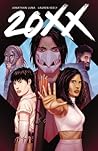
Review: 20XX, Vol. 1

20XX, Vol. 1 20XX, Vol. 1 by Jonathan Luna
My rating: 2 of 5 stars

Ever been on a first date and you realize about halfway in that you don't even like the person you're on the date with. I don't mean hate them, but rather that they're just annoying. You don't even really want to be vague social media buddies much less romantic partners that are allowed to invade each other's personal space. The worst part is that you feel pressured to finish the date enough though the relationship has already failed. That's what it felt like reading this book. Nothing to really hate, but it was annoying to finish because I felt pressured to do so. I think mostly so I could complain about it in this review.

The reason I choose the dating analogy was because this book has a lot of post-teen social drama. Every character in this book is at that awkward age where they can legally have sex but still can't be compelled to behave like an adult most of the time. I found myself skimming the unreasonably large text bubbles that were mostly people venting their unearned emotions. Whenever someone is discussing plot or literally taking an exposition dump, their voice is far more concise. But when they're unpacking their emotional baggage, they'll hold the plot hostage for several pages until they're finished.

It's just bad writing all around. Bloated dialogue aside, there's almost no intelligent world-building or engaging characters. The pacing is downright horrible and several issues end with the exact same cliffhanger of the 'villain' looking at someone and making a statement that doesn't impact the story as much as the comic seems to think it does. It just doesn't effectively utilize anything. And I mean anything. Even naked boobs.

The art was obviously meant to be in color. There's a difference in how artists draw if the art is going to be colored in later compared to knowing it's going to stay black and white. The art in 'The Walking Dead' works because it was always meant to be in B&W. Sure, it looks fine colored in but remains in its best effect if it stays without color. The art, at least to me, looks as if they planned to add color but backed out after the fact. Either it was a money or bad artistic decision. Doesn't really matter. I doubt I would have enjoyed the art even if it was in color.

If it isn't obvious by now, I didn't care much for this book. I'm not disappointed because that implies this book showed promise. It did not. It wasted some of my life, but, to be fair, it is my life to waste. My only regret is that I just didn't get up and leave without even paying the bill.

View all my reviews

Thursday, April 22, 2021

Review: Death's End

Death's End Death's End by Liu Cixin
My rating: 4 of 5 stars

I'm surprised this book is only six hundred pages. Seriously, that's my first takeaway after finishing this book. It might be in part that I took my time reading it, but it's mostly because of how dense the story is. Most other writers would have taken the outline of this one book and expanded it over several novels. It reads more like a fictionalized history book of the future than typical novelizations. Each section world building a different era as it uncovers the story of the last two books straight through to the literal end of time. That's not a knock against it, but rather something you need to know before diving in.

If you read the first two novels in the series, and seriously why wouldn't you have, I'm hesitant to say you'll feel right at home in the last installment. It's not so much that it's written in a profoundly different way, but rather that it leans more heavily on its world-building strengths. This is especially true in the latter half of the book where, to be honest, not a lot happens in terms of plot. The characters, more or less, become passive observers to the end of fake history. Again, this isn't a knock against it, but it might be a turn-off to those who are used to lighter reads.

Though one knock against it is, much like the previous book, its main character is the least interesting of the bunch. Not as passive as Luo Ji, but Cheng Xin still feels like more of an observer than a character that drives the plot. Luo Ji got a pass because being passive was part of who he was as a person, but here I'm not so sure about Cheng Xin. In fact, I don't have a strong sense of her at all except when she is being reflected off Yun Tianming. This might be because I'm more of a Sophon/Thomas Wade kind of guy, but others might make the same observations. At least Cheng Xin did two important plot-related things in this book, and it's one more than Luo Ji.

While the characters might add a little color to the mix, I would urge that most readers aren't here for that. Rather they're here for the intense world-building, wonderful prose, and a level of scientific ideas we rarely see in the genre. It's a profound book that caps off a profound series. Probably the biggest knock against it is that there isn't more of it. I honestly believe with a more expansive dive into the world and characters that this could have made it into a twelve-book series. Would I have read twelve books like this? I don't know, but I feel like I already have.

One last reader beware warning: don't read this book if you're easily depressed. Some describe this book as "dark" and/or "grim", but I would disagree. It has more of a nihilist quality to it. The narrative not so much being cruel as it is uncaring in a way that would make Nietzsche proud. If I had to pick one word to describe this book, it would be "sad". Because it isn't sad that everything dies, it's sad that everything ends.


View all my reviews